Stabilize the Foundation
2026-29
The three-year operating plan is designed to move USQ from instability toward sustainable infrastructure. It serves as the foundation for the league’s long-term vision: US Quadball is a league built for a lifetime. From accessible youth leagues in major cities to sustainable college programs and a thriving club ecosystem to an engaged alumni network, the pathway is clear at every stage. USQ is built to endure and ensure quadball continues to grow and thrive across generations.
Between 2026 and 2029, the league will focus on stabilizing participation, improving retention rates, and diversifying revenue streams. Rather than prioritizing rapid expansion, this plan emphasizes sustainable growth, operational consistency, and systems that reduce reliance on reactive crisis management and intensive volunteer labor.


Focus: Stop the bleeding, hit the baseline floor, launch pilots
✓⃝ Stabilize at-risk college programs
✓⃝ Reactivate lost programs
✓⃝ Launch youth pilots in four cities
✓⃝ Introduce low-commitment club formats
✓⃝ Revenue stabilization and diversification begins

Focus: Expand recruitment, build college-to-club pathways, increase local play
✓⃝ Expand college recruitment
✓⃝ Formalize college-to-club pipeline
✓⃝ Increase club participation
✓⃝ Scale youth pilots
✓⃝ Grow sponsorships and event revenue

Focus: Meet full baseline targets, restore regional systems, make growth repeatable
✓⃝ Diversify club landscape
✓⃝ Youth programs become repeatable
✓⃝ Improve retention across all levels
✓⃝ Strengthen regional play
✓⃝ Hit 3-year baseline metrics
EXPLORE THE PLAN
YEAR ONE
-
Stop net loss of teams
Achieve baseline minimum for active teams (57)
Limit player participation decline to <1%
Key Actions
College (Primary Driver of Baseline)
Stabilize at-risk programs
Reactivate five lost programs
Prevent further decline (add 21 players and one total team)
Improve retention of existing teams (stabilize loss of current teams to only one)
Club
Maintain current participation while reducing churn (increase by eight players and stabilize decrease of teams to only four)
Introduce no-contact and/or low-commitment formats
Enact methods to prevent drop-off due to cost and burnout
Youth
Launch eight pilot programs across four cities contributing to baseline
Achieve first measurable youth participation numbers
-
Hit minimum viable revenue target of $310,045
Maintain dues revenue stability
Increase non-dues revenue stream to 51% of total revenue
Key Actions
Revise and relaunch entry-level sponsorship packages
Optimize membership structure
Optimize event pricing
Pilot youth program revenue (10.22% of revenue)
Host quarterly targeted donation campaigns
-
College → club transition rate: 20%
Volunteer retention rate of 80%
Key Actions
Reduce volunteer overload
Introduce recognition system
Continue to clarify role definitions
Further standardize operations
Build graduating player database
Launch direct outreach forms/processes
Pilot club-to-college connection systems in key regions
-
Participation decline decreases (loss of only three total teams)
Revenue stabilized
Baseline metrics achieved or narrowly missed
YEAR TWO
-
Add 74 new college or club players
Add five new college teams
Provide a USQ Invitational opportunity in each region with seven or more official
550 youth players annually
Key Actions
College (Primary Driver of Baseline)
Further expanded recruitment efforts
Club
Formalize the college to club pipeline via direct mentorship relationships between college and club teams in their own cities
Expand participation capacity
Increase regional density
Youth
Scale from pilot to repeatable programs
-
Increase total revenue by 10%
Increase non-dues share to 52%
Key Actions
Expand sponsorship inventory
Events
Youth programs
Improve event monetization
Tickets
Vendor activations
Begin multi-event sponsorship deals
-
College → club transition rate: 22%
Volunteer retention rate of 83%
Key Actions
Outreach to new grads in May and August with opportunities
Alumni engagement pathways
Regional leadership systems
Majority of graduating players contacted before graduation
Increased club participation in recruitment efforts
-
Participation growth becomes consistent
Revenue begins shifting away from dues
Increase in playing opportunities
YEAR THREE
-
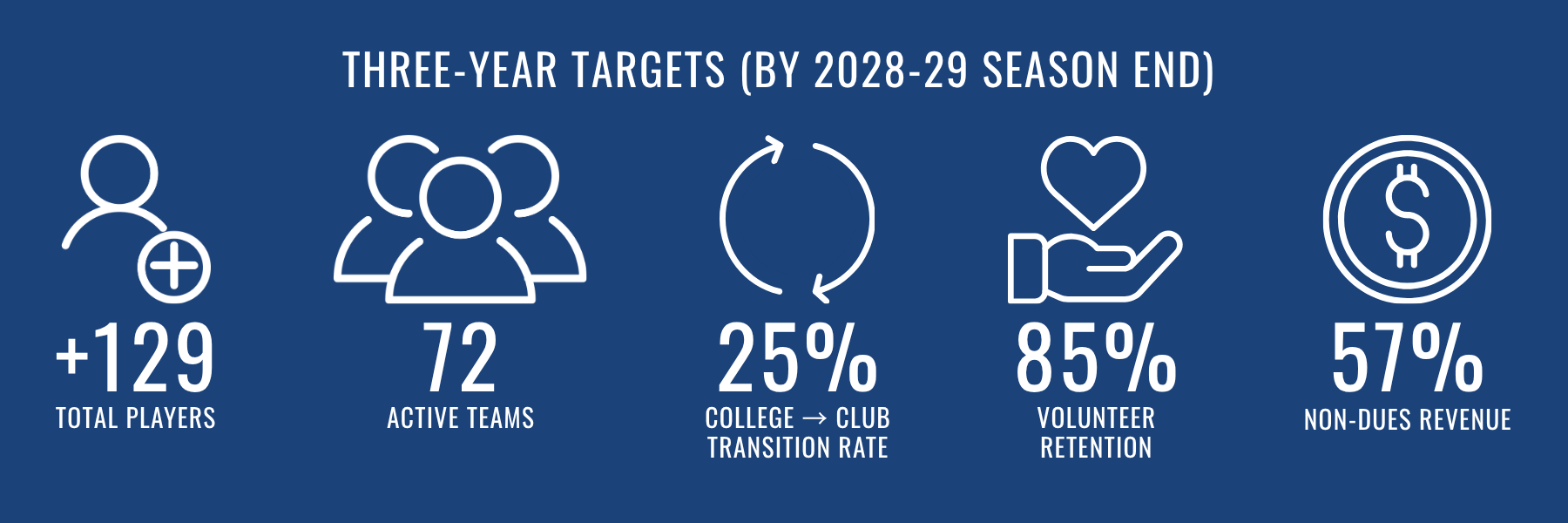
Hit or exceed total players baseline of 1179
Hit or exceed total team count of 72
Key Actions
College → club → alumni pipeline functioning as intended
Track and optimize conversion rates
Return of regional coordinator program
Teams no longer in isolation
Growth becomes self-sustaining on a local level
-
Hit full baseline revenue targets
57% non-dues revenue
Key Actions
Secure $5,985 in sponsorships and/or licensing deals
Scale youth program revenue to $39,900
Scale event revenue profitability to $45,000
-
College → club transition rate: 25%
Volunteer retention rate of 85%
Key Actions
Expand alumni roles
Introduce further professionalization
Transition systems active in every region
Standardized graduating-player outreach leaguewide
Club recruitment integrated into annual offseason operations
-
Player baseline met or exceeded
Revenue baseline met with diversified streams
USQ operating as a stable, scalable system
3-Year Financial Narrative
The first three years of this plan are about stabilizing the organization and rebuilding the base. For several years now, USQ has either been shrinking or treading water in key areas, especially participation and outside revenue. The goal here is not explosive growth or trying to recreate the biggest years the organization ever had overnight. It is about building something steady that can actually last. Between 2026 and 2029, the projection calls for adding roughly 129 total players, including about 75 college players and 44 club players, while also increasing youth participation by at least 10%. That would put the organization back on a healthier trajectory without stretching operations beyond what we can realistically support.
Just as important as adding players is keeping people involved. A huge part of this phase is focused on retention and organizational stability. Part of this is the targets of roughly 40 active college teams and 32 active club teams by Year 3, but the larger issue is making sure teams survive from season to season and players stay connected to the sport after college. That is why the plan focuses heavily on improving the college-to-club pipeline, increasing year-over-year team survival, and retaining volunteers and officials who keep the league operating. If we cannot keep teams, volunteers, and leadership in place consistently, growth itself does not really matter.
Financially, the projection assumes moderate but steady growth rather than major leaps. Revenue would grow by roughly $89,000 over the three-year period, driven mostly by events, memberships, merchandise, and gradual increases in sponsorship and outside support. Event revenue will still be the backbone of the organization during this phase, while sponsorship revenue is expected to grow slowly as the organization becomes more stable and credible externally. At the same time, the organization would work to cautiously build staffing and infrastructure so that USQ can move away from the current model, which depends far too heavily on a small number of overextended volunteers and a single, overworked full-time employee. The overarching financial goal of the first three years is simply to get the organization into a healthier, more sustainable position where long-term growth actually becomes possible.
Note: These projections are intended to serve as baseline financial models tied to USQ’s long-term strategic planning process. They are designed to show a realistic path through which the organization could potentially reach the participation, operational, and financial goals outlined in this plan. They are not formal operating budgets or exact predictions. More detailed annual budgets, benchmarks, and priorities will still need to be developed each year based on the organization’s actual financial position, participation levels, staffing, and event performance at that time.
Long-term strategic plans are meant to establish direction more than precision. The purpose of a 10-year plan is not to predict exactly where the organization will be in 2036, but to define what kind of organization USQ is trying to become and what a sustainable path toward that future could look like. These projections are therefore intentionally aspirational while still grounded in USQ’s recent financial history, current realities, and realistic assumptions about steady long-term growth.
WHAT THIS MEANS
By 2029, USQ should no longer be operating in constant recovery mode. The goal is to stabilize participation, rebuild the pipeline from college to club, establish youth programming, and create repeatable systems that make growth less dependent on emergency volunteer effort.