Strengthen the Framework
2026-31
The five-year operating plan is designed to bridge the gap between USQ’s recovery phase and the league’s long-term 2036 vision: US Quadball is a league built for a lifetime. From accessible youth leagues in major cities to sustainable college programs and a thriving club ecosystem to an engaged alumni network, the pathway is clear at every stage. USQ is built to endure and ensure quadball continues to grow and thrive across generations.
The three-year operating plan outlined our focus on stabilization and infrastructure. Years four and five focus on regional maturity, operational professionalization, further revenue diversification and positioning USQ as sustainable long-term–beyond crisis management and volunteer dependency.
Over the next five years, USQ will prioritize:
Sustainable participation growth over rapid expansion
Regional density over isolated teams
Retention alongside recruitment
Systems over heroic volunteerism
Revenue diversification over dues dependency
Accessibility and inclusion alongside competitiveness
Long-term durability over short-term optics

Reverse participation decline
Rebuild college pipeline
Launch youth programs
Diversify revenue
Build core operational systems

Strengthen regional ecosystems
Expand summer quadball
Add regional coordinators
Improve media and broadcasts
Grow alumni engagement
Secure larger sponsorships
EXPLORE THE PLAN
YEAR ONE-THREE RECAP
-
Total players: +129
Youth participants: +10%
College players: +75
Club players: +44
-
Active college teams: 40
Active club teams: 32
-
College → club transition rate: 25%
Year-over-year team survival: 80%
Volunteer retention: 85%
-
Total revenue growth: +$88,939
% non-dues revenue: 57%
Total event revenue: $389,935
Total sponsorship revenue: $13,965
YEAR FOUR
-
Total player members: 1,250
College players: 640
Club players: 570
Establish recurring youth programming in multiple regions
Increase local playing opportunities and regional density
Key Actions
Fully relaunch regional coordinator/state representative program
Create regional hub expectations:
Recruitment
Local scheduling
Youth outreach
Officiating development
Club-college collaboration
Expand:
Developmental competition
Recreational and no-contact formats
Summer quadball infrastructure
Reduce geographic isolation by increasing number of conferences or similar clustered growth models
-
Increase total revenue by 45% (over Year 1 revenue)
Increase non-dues share to 59%
Secure $6,750 in sponsorships and/or licensing deals
Scale youth program revenue to $45,000
Key Actions
Develop:
Youth sponsorship inventory
Regional sponsorship packages
Expand:
Merchandise strategy
Vendor partnerships
Local event monetization
Increase destination and host-city partnerships
-
College → club transition rate: 27%
Volunteer retention rate of 86%
Key Actions
Alumni mentorship systems in every region
Leaguewide graduating-player outreach system fully standardized
Expanded leadership development resources
Club participation integrated into offseason recruitment efforts
-
Event Quality
Standardized event expectations nationwide
Reliable schedules and communication across all tournaments
Improved spectator experience and venue presentation
Officiating
Launch advanced officiating development pathways
Regional practical clinics and video review systems
Improve officiating consistency metrics
Marketing
Standardized stream packages for major events
Improved storytelling and onboarding content for new audiences
More accessible explanations of gameplay and rules
-
Regional ecosystems become operationally self-sustaining
Participation growth expands beyond core markets
Revenue diversification significantly reduces reliance on dues and emergency fundraising
YEAR FIVE
-
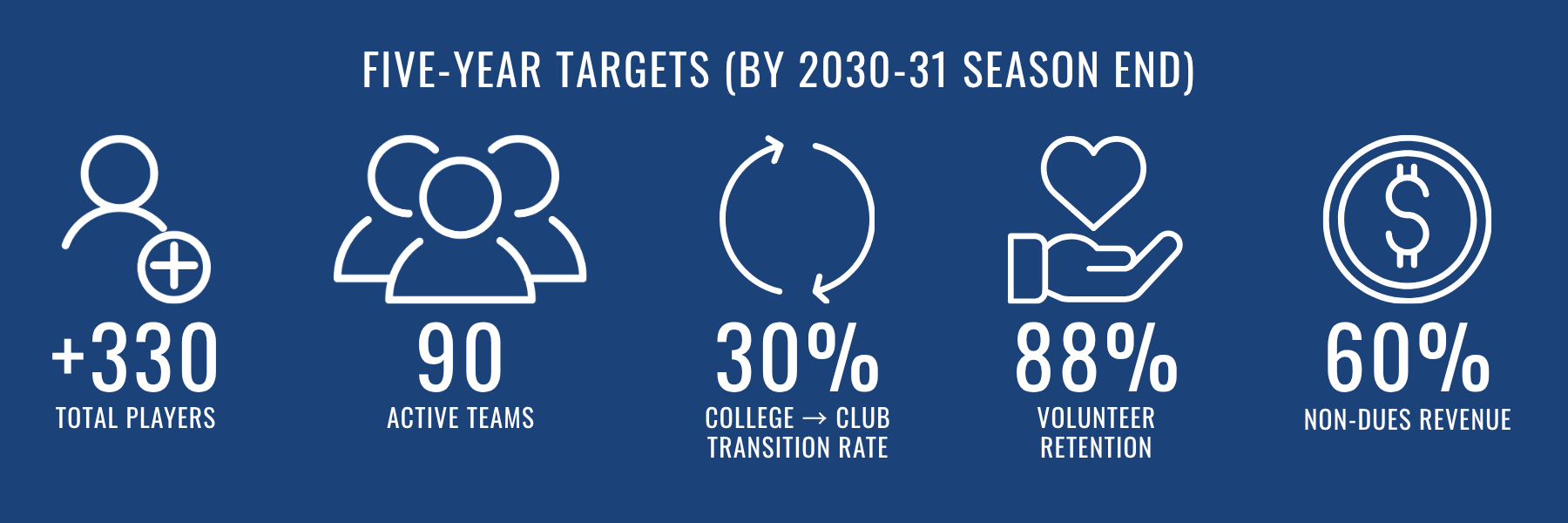
Total player members: 1,380
College players: 720
Club players: 610
Expand youth participation into a sustainable national intake system
Key Actions
Increase geographical access to local play opportunities
Formalize:
Alumni engagement system
Long-term volunteer pathways
Adult low- to no-contact recreational pathways
Expand club support infrastructure in underserved regions
Youth
Expand into markets in which youth has not yet been established. This may be schools, recreation departments, community organizations, and/or camps
-
Increase total revenue by 64% (over Year 1 revenue)
Maintain non-dues share at 60%
Secure $7,650 in sponsorships and/or licensing deals
Scale youth program revenue to $51,816
Key Actions
Secure a major national- or international-level sponsor
Package:
Streaming
Events
Youth initiatives
Inclusion initiatives
Scale event profitability
Build reserve fund strategy
Expand licensing opportunities
-
College → club transition rate: 30%
Volunteer retention: 88%
Key Actions
Expand low-commitment and recreational play formats
Reduce leadership turnover impact
Expand alumni coaching, officiating, mentorship, and donor pathways
Strengthen local leadership succession planning
-
Event Quality
Expand fan activations, entertainment, and community engagement at marquee events
Improve accessibility standards and accountability measures at marquee events
Officiating
Create sustainable regional officiating leadership structures
Expand retention and mentorship systems for new officials
Increase certification standards and accountability measures across competitive divisions
Marketing
Expand media coverage and broadcast quality at key local events
Build stronger regional and local community visibility
-
USQ operates as a durable, nationally-connected league ecosystem
Participation, retention, and revenue growth are sustained year-over-year
The league is positioned for long-term expansion beyond recovery and stabilization
5-Year Financial Narrative
Years four and five are about turning the stability gained during the first three years into something sustainable long term. The goal is for USQ to no longer be in constant recovery mode, but instead functioning as a consistent national league with a stronger regional infrastructure, healthier operations, a small but engaged staff, and a clear long-term direction. The emphasis remains on steady, manageable growth rather than trying to force expansion the organization cannot effectively support.
By Year 5, USQ should be moving from recovery into credibility. The participation targets rise to roughly 45 active college teams and 41 active club teams, with total player growth of about 330 from the 2026 baseline. That growth is only meaningful if retention improves with it, so this phase puts more weight on the college-to-club transition, year-over-year team survival, and volunteer retention. In the three-year plan, we are trying to rebuild the pipeline. By the five-year mark, that pipeline should be functioning well enough that USQ can begin relying on it instead of constantly rebuilding from scratch.
Operationally, Years 4 and 5 focus heavily on consistency and professionalism. That includes more standardized events, better tournament communication, stronger officiating systems, more accessible broadcasts, and improved public visibility for the sport overall.
Financially, the five-year plan is also a step forward from the first phase. The three-year plan gets the organization healthier. By this point, the aim is to make it more resilient. Revenue is projected to grow by roughly $233,000 over the 2026 baseline, with event revenue still carrying much of the budget, but with sponsorships, merchandise, youth programming, and other outside support becoming more meaningful. This is also where staffing and systems need to become more professional, not just bigger. By Year 5, USQ should be less dependent on emergency volunteer effort, better able to run consistent events, and more prepared to present itself as a serious, sustainable niche sports organization.
Note: These projections are intended to serve as baseline financial models tied to USQ’s long-term strategic planning process. They are designed to show a realistic path through which the organization could potentially reach the participation, operational, and financial goals outlined in this plan. They are not formal operating budgets or exact predictions. More detailed annual budgets, benchmarks, and priorities will still need to be developed each year based on the organization’s actual financial position, participation levels, staffing, and event performance at that time.
Long-term strategic plans are meant to establish direction more than precision. The purpose of a 10-year plan is not to predict exactly where the organization will be in 2036, but to define what kind of organization USQ is trying to become and what a sustainable path toward that future could look like. These projections are therefore intentionally aspirational while still grounded in USQ’s recent financial history, current realities, and realistic assumptions about steady long-term growth.
WHAT THIS MEANS
By 2031, USQ is no longer recovering. Regional ecosystems operate independently. The college-to-club pipeline functions consistently. Youth programs are repeatable. The organization has the profeessional systems necessary for long-term success.