
Registration opened Tuesday for the 2026-27 US Quadball season. Now that recruitment season is officially underway, I want to take an (extended) moment to talk about just how important the next few weeks are for the future of our sport.This blog post isn’t short, and it isn’t sweet. Some of what follows is daunting and, frankly, depressing. But it’s also correctable—especially during recruitment season. And if we correct it, we can fundamentally change the trajectory of our sport.
During the strategic planning process, I found a number that I haven’t stopped yapping about: from the end of the 2022-23 season through the conclusion of the 2025-26 season, we lost approximately 85% of graduating college players from the sport.
That’s not a small group of people: 746 players graduated and left quadball entirely.
For the remainder of this blog I’ll discuss where these numbers came from, what they mean, and where we go from here. Everyone in USQ should read what follows. But if you’re in club leadership, consider this required reading for you and your players.
USQ College-to-Club Pipeline Analysis
This analysis examines the current state of the USQ’s college-to-club pipeline using roster history and inferred graduation data from recent membership records. The goal was to better understand how effectively players are transitioning from college participation into club participation. Data was collected from the 2022-26 SportsEngine registrations.
For the purposes of this analysis:
A player was considered part of a “graduating cohort” if it was their final recorded season on a college roster. This does not fully account for players who leave college before exhausting their eligibility or transfer to schools without active quadball programs, but it best summarizes and represents the most complete data currently available.
A player was considered to have “transitioned” if they appeared on a club roster the following season.
Players with no subsequent participation were considered lost post-college.
Standard four-year college assumptions were used unless otherwise indicated in registration data.
Annual College-to-Club Pipeline Breakdown and Results
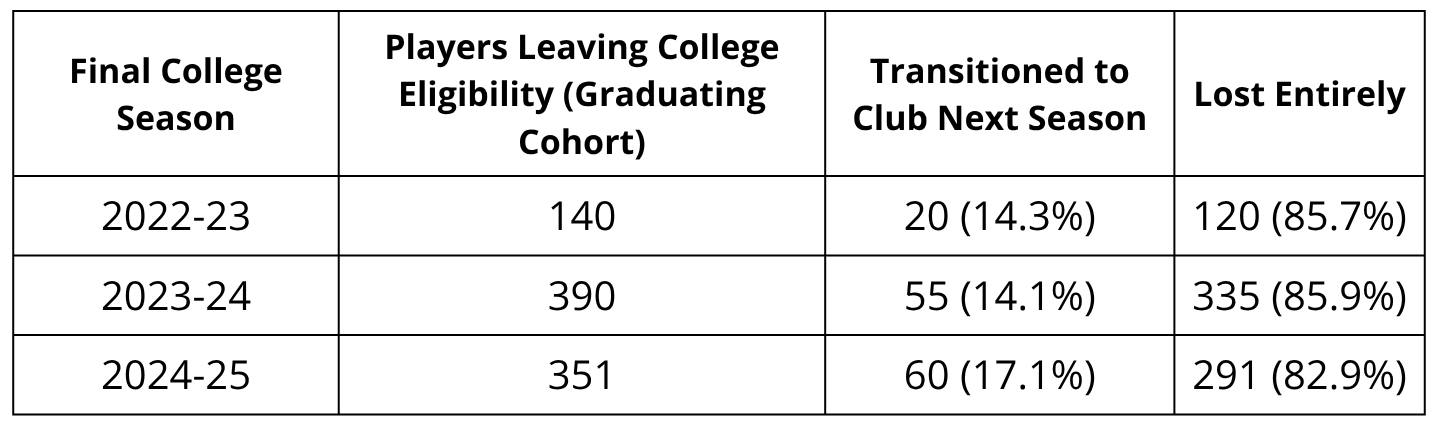
Across the three analyzed graduating cohorts:
881 players exhausted college eligibility
135 players transitioned into club play
746 players left the sport entirely
Overall rates:
15.3% college-to-club transition rate
84.7% post-college attrition rate
Key Findings
1. The overwhelming majority of graduating players leave the sport entirely.
The data shows that once players complete their college careers, most do not continue participating in USQ in any capacity—they don’t play, officiate, coach, or direct tournaments. Maybe they show up as the occasional spectator. Roughly five out of every six graduating players disappear from organized participation the following season.
This is not primarily a problem of players remaining in college eligibility longer than expected or delaying their transition. Very few players continue appearing on college rosters after their expected graduation timeline. Instead, the trend is direct attrition out of the sport.
2. The college-to-club transition rate has remained relatively flat.
The transition percentage has stayed fairly stable:
14.3%
14.1%
17.1%
3. The pipeline currently does not function as a sustainable long-term player pathway.
The data strongly suggests that USQ does not currently have a reliable structural off-ramp from college participation into club participation. This creates a recurring cycle where:
College teams recruit and develop players
Players graduate
Most leave the sport entirely
Club programs struggle to replenish rosters
Overall player participation declines over time
If we continue on this trajectory, the last bullet will be club teams die out.
Likely Structural Causes
While this analysis is quantitative rather than survey-based, the numbers point toward several likely contributing factors.
First and foremost, there is limited club availability in many geographic areas. Localized club teams are now fewer and farther between than ever before, and there are only a limited number of club teams that regularly hold practices and maintain stable operations year-over-year. Graduates are increasingly choosing to join existing established clubs rather than starting new ones alongside fellow graduates (shoutout Chicago Windchill for going against the grain this season). While that strengthens a small number of existing organizations, it also concentrates players into fewer spaces, reduces opportunities for local growth, and leaves many regions without sustainable post-college participation pathways.
Adding onto the limited availability is the lack of low-commitment or localized participation opportunities for recent graduates. In large portions of the country, the only consistently operating teams are highly-competitive club programs. For many graduating players, that environment can feel financially demanding, travel-heavy, time-intensive, or socially intimidating compared to the more accessible and community-oriented experience they had in college. Recreational, developmental, pickup, and regional-level participation structures are either inconsistent or nonexistent in many areas, leaving players with an all-or-nothing choice between high-level competitive play and leaving the sport entirely.
Whether by nature of limited roster spots, a desire among graduates to continue playing only with existing friends, geographic relocation after college, or simple burnout after years of competition, it is also clear there is weak and/or inconsistent recruitment of graduating college players by club teams. In many regions, there is no formalized outreach process to graduating players, no active relationship between nearby college and club programs, and little direct communication encouraging players to continue participating after graduation. I even found this year in my college team exit interviews that some club teams that claimed they were supporting a college team actually were not.
This is also informed by firsthand experience. I spent roughly a decade involved in USQ club play, including time with both highly-competitive club structures and developmental/B-team environments. There is a noticeable difference in accessibility, onboarding, and long-term retention between organizations that intentionally create multiple entry points for players and organizations that operate solely around top-level competition. B-teams and lower-pressure participation opportunities historically helped retain players who otherwise may not have stayed involved. As those structures have declined in many regions, so have many of the natural pathways for post-college retention.
Some club teams recognize this challenge and actively work to integrate some graduating players into their communities, but many still underestimate the social transition that occurs after college. Graduation inherently comes with the loss of campus-based community and built-in social structures. For many young adults, activities like quadball, running clubs, intramural leagues, or book clubs are not simply hobbies. They are ways to recreate community, friendship, routine, and belonging after leaving college.
While there are certainly players who simply want to show up, compete, and go home, the majority of people who continue participating in quadball post-college do so because they want to feel connected to a team and a community. They need new local friends when their college friends scatter across the country. Teams that successfully retain players often create strong social environments outside of tournaments and practices, making players feel wanted and integrated beyond just their on-field value.
It is also important to recognize that this is not exclusively the responsibility of club teams. There are broader structural barriers contributing to attrition, including rising travel costs, relocation after graduation, new work schedules, graduate school demands, burnout, and the general challenge of maintaining adult recreational participation in a niche sport. However, the current system provides very few intentional mechanisms to help graduating players navigate those barriers and remain connected to the sport.
At present, the transition from college to club participation is largely passive. Unless they’re a top player, graduates are expected to independently locate teams, integrate into existing social circles, manage increased financial obligations, and maintain participation during one of the most transitional periods of their lives.
Unsurprisingly, many do not make that transition successfully.
Strategic Implications
This analysis suggests the college-to-club transition may be one of the single largest structural pressure points impacting long-term participation and organizational sustainability. Addressing this issue requires intentional infrastructure rather than relying on organic transition alone.
Potential areas of focus include:
Club expansion initiatives
Regional pickup and low-commitment play systems
Graduating player placement programs
“Find Your Club” outreach campaigns
Targeted recruitment of graduating seniors
Takeaways and Next Steps
Circling back to the total number of graduates lost in total post-2022-23 season: 746. That’s a big number. It’s even bigger when you realize it’s the equivalent of ~41 teams with 18-person rosters. While it’s unrealistic to expect every single college graduate to play post-college, that’s an unacceptable loss for a sport of our size. To put it yet another way, based on the data presented:
1 in 7 players successfully transition into club
6 in 7 players are lost entirely after college
Improving this pipeline is essential for long-term player retention, club sustainability, and overall organizational growth.
Based on May’s data, there are 339 graduates in the pipeline data. That’s 339 potential club players across the U.S.
Let’s get into a couple of the steps I’m taking toward retaining these players.
USQ Graduate Placement Program
Earlier this summer, I began building a USQ Graduate Placement Program. I reached out to every college team and asked that their departing players complete a form that feeds into a tracker where we can follow their post-college journey. This includes whether they join a club team, become an official, start volunteering, or find another way to stay involved in the sport.
I’m still following up with teams to collect the names of departing players (a lot of you are very averse to checking your email), but those who have completed the form have given USQ detailed information about their post-grad plans: where they’re headed, whether they want to be connected with a local club team, whether they’re interested in starting a team of their own, and more.
Outreach to those individuals kicked off this week. The goal is simple: instead of hoping graduating players find their own way to stay in quadball, USQ is going to actively help them find it.
Low-Stakes Quadball
My Executive Assistant Erin Moreno collected and posted all summer about local, low-stakes quadball opportunities. We’ll continue to post about these and fantasy tournaments even outside of the summer. We’ll help promote them where we can.
We recently onboarded Emily Hickmott to work with city partners to pilot more low contact, low entry modes of play. She has extensive experience in all facets of the sport and is one of the few in the community who knows how to navigate the bidding process and work directly with sports commissions and cities. We’ve got something up our sleeve for next summer with more info to come at a later date.
Promoting these low-commitment level opportunities gives players the chance to continue playing when they might be in a transitory stage. It gives players a low-stakes alternative to following up one potentially high-level competitive season with another, while not requiring them to forgo the game entirely in the process. The ask is simpler: “Come play for one weekend, when you can”. Our community continues to be a place they can see themselves no matter what stage they’re at in life.
The Money Problem
This sport is expensive to participate in, but so is nearly every organized recreational sport. While I can’t give you free quadball across the board, I can work to make it more accessible. This season, I revamped our grant program, and we were fortunate to receive additional funding from a member of the community who simply wants to see the sport they love flourish.
That doesn’t mean everyone who applies for a grant will receive one—the funds aren’t unlimited—but the financial support available this season is the most substantial it has ever been. Review our grants and apply here.
And if you’re a club player who doesn’t have the time to give back to college quadball but does have the financial means to help, send me an email at amanda.dallas@usquadball.org. I can point you directly toward teams and players who could use your support.
Teams Aren’t Off the Hook
Rebuilding and sustaining the club division cannot fall solely on me, my volunteers, and our donors—especially as we work to stabilize college and grow youth, as well. Frankly, there’s only so much that can be accomplished at the CEO’s front desk.
College teams need to encourage their players to keep participating in the community on their way out. Club teams need to actively recruit graduating players, build relationships with nearby colleges, and pitch players on continuing to play after graduation. That was how some of the strongest club programs in this sport’s history were built.
If your team doesn’t have room for a player who reaches out, connect them with a nearby team that does. If your organization consistently has enough interest to roster 12+ additional players, create a sister team, B-team, developmental squad, or recurring pickup structure to retain those players in the community instead of turning them away.
We are currently losing the vast majority of graduating college players from the sport entirely. Reversing that trend will require active participation from every level of the community. This cannot be treated as someone else’s responsibility. It’s all hands on deck if we want to build a sustainable future for the sport.
✅ Weekly Action Item
It’s on you, club players. Reach out. Pick a college team, DM them on Instagram, and ask them if they have any graduates moving to your team’s city. Ping me directly to find out which college grads might be moving to or are living in your area so you can reach out.
What have you got to lose?